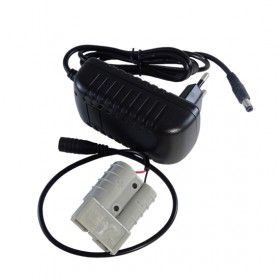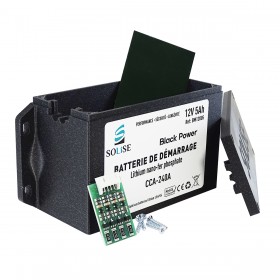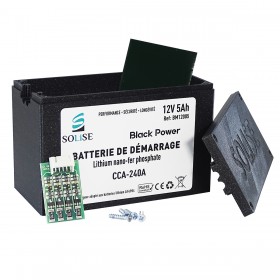
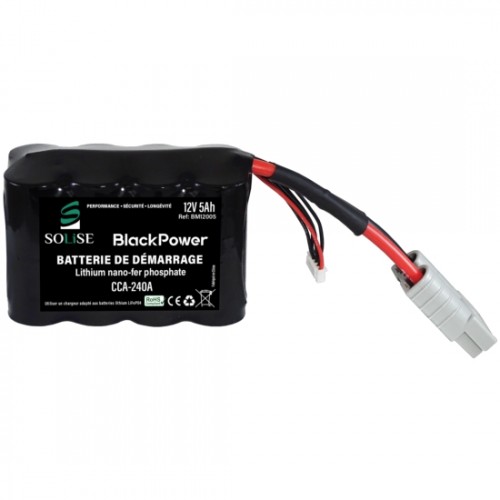


Batterie de démarrage lithium 12V CCA-240


RECOMMENDATIONS FOR USING LITHIUM SOLISE BATTERIES
To ensure optimal, safe performance and long life for your SOLISE lithium batteries, we recommend that you follow these guidelines :
USE AND RECHARGING
- Suitable charger : Use a charger specifically designed for lithium batteries to optimize recharging.
- Prolonged storage : In the event of prolonged storage, recharge after 18 months.
- Complete discharge : If the battery is completely discharged until the BMS (Battery Management System) switches off, it is crucial to recharge it within 24 hours.
- Quality connection : Make sure the battery connection is of good quality to avoid any operating problems.
PRECAUTIONS FOR USE
- Do not open : Do not attempt to open the battery.
- Do not immerse : Do not immerse the battery in liquid.
- Do not expose to flames : Keep the battery away from sources of ignition.
- Discharge current : Do not exceed the recommended continuous discharge current.
- Recharging temperature : Do not recharge the battery at a temperature below 0°C.
- Exposure temperature : Do not leave the battery exposed to temperatures above 60°C.
RECYCLING USED BATTERIES
These products must not be thrown in the bin. SOLISE works with the Screclec organisation to take care of used batteries. You can return them to the waste collection centres so that they can be recycled appropriately.
RECOMMENDATIONS FOR USING LITHIUM SOLISE BATTERIES
To ensure optimal, safe performance and long life for your SOLISE lithium batteries, we recommend that you follow these guidelines :
USE AND RECHARGING
- Suitable charger : Use a charger specifically designed for lithium batteries to optimize recharging.
- Disconnection : Disconnect your battery if you are not going to use it for more than 2 weeks, to avoid deep discharge.
- Prolonged inactivity : If you've never used your battery after purchasing it, you'll need to recharge it after 18 months.
- Quality connection : Make sure the battery connection is of good quality to avoid any operating problems.
STORAGE
- Wintering : If you're using your battery and want to store it for the winter, you'll need to fully recharge it. You can then store it for up to 18 months without risk.
PROTECTION AND SAFETY
- Exposure to water : Protect the battery from splashing water and damp environments to avoid the risk of short-circuiting and corrosion.
- Short circuit : Do not short-circuit, as this may cause irreversible damage and a fire hazard.
- Exposure to flames : Do not expose the battery to flames.
- Protective casing : Do not remove the plastic protective casing, which provides electrical insulation and mechanical protection.
CHARGING CONDITION
- Temperature : Do not recharge the battery at temperatures below 0°C or above 60°C. To prevent overheating, avoid placing the battery too close to the engine.
- Recharging voltage : Your alternator must not recharge the battery at a voltage higher than 14.6V.
- Discharging : Do not discharge the battery below 9V.
These batteries have no protection against overcharge, deep discharge or short-circuit.
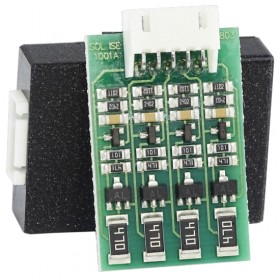
We strongly recommend the addition of our balancing card (part no. ACC009), which balances the cells during charging, thus extending battery life. Once installed, the balancing board must not be disconnected.
THE CONSEQUENCES OF MISUSE
- Loss of technical characteristics : If these recommendations are not followed, the battery may lose its technical characteristics irreversibly and will not be covered by warranty.
- Fire hazard : If misused, the battery can catch fire.
RECYCLING USED BATTERIES
These products must not be thrown away. SOLISE works with the Screlec organisation to take care of used batteries. You can return them to your local waste collection centre for proper recycling.